

More exfoliation isn’t always the answer to rough or uneven-looking skin. If you’re wondering how to improve skin texture on face, start by noticing what you’d like to address, then choose care your skin can tolerate consistently.
It’s understandable to feel unsure when advice about exfoliants, retinoids, and professional treatments seems to point in different directions. Texture can be influenced by several factors, including buildup of dead skin cells, visible pores, past acne, sun exposure, and changes in collagen over time. A routine that helps with one concern may irritate another, so adding multiple active ingredients at once can make it harder to tell what’s working.
This guide will help you identify common contributors, build a gentle home-care routine, and decide when a professional opinion may be useful. We’ll also cover customized medical facials, chemical peels, and microneedling, options a provider may discuss based on your skin and goals. A steady, personalized approach can help you make informed choices without treating every bump or rough patch the same way.
Key Takeaways
- Learn how different visible texture concerns can have different contributors, so you can focus on the concern that matters most to you.
- Discover how to improve skin texture on face with a simple, consistent routine built around cleansing, moisturizing, and daytime sun protection.
- Understand how at-home care and professional treatments differ, and why an in-office option isn’t automatically the next step.
- Use a practical framework to review your current routine, track changes, and make thoughtful adjustments without adding products all at once.
- Explore how an education-first consultation at Reviive Lounge in Chino can help you discuss whether customized medical facials, microneedling, or chemical peels may suit your goals.
What Causes Uneven Skin Texture on the Face?
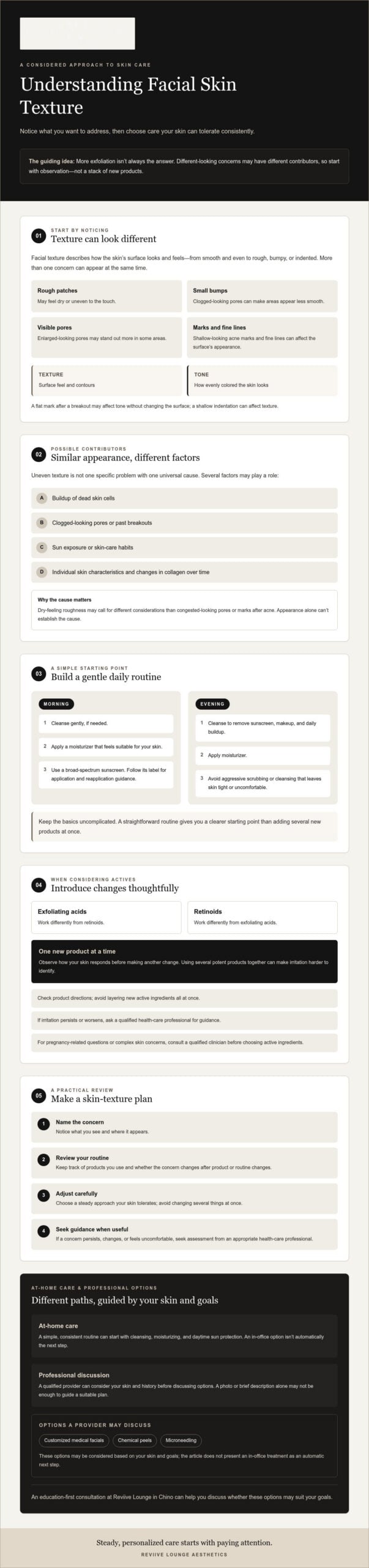
Facial skin texture describes how the skin’s surface looks and feels, from smooth and even to rough, bumpy, or indented. Uneven texture isn’t one specific problem with one universal cause. Dead-cell buildup, clogged-looking pores, past breakouts, sun exposure, skin-care habits, and individual skin characteristics may all play a role.
The surface is only part of the picture. Skin has several layers and structures, as outlined in this overview of the structure of human skin. Changes at the surface can look similar even when their contributors differ, so appearance alone can’t establish a cause. When considering how to improve skin texture on face, start by noticing what you see rather than immediately adding a strong product or procedure.
Common ways facial texture concerns appear
Texture concerns can show up in different ways, sometimes at the same time:
- Rough patches may feel dry or uneven to the touch.
- Small bumps or clogged-looking pores can make areas appear less smooth.
- Enlarged-looking pores may be more noticeable in some parts of the face.
- Shallow-looking acne marks can create small dips or irregularities in the surface.
- Fine lines may affect how smooth or uniform the skin appears.
Texture and tone are related, but they aren’t the same. Texture refers to the surface’s feel and contours; tone refers to how evenly colored it looks. A flat mark left after a breakout may affect tone without changing the surface, while a shallow indentation can affect texture. Note where a concern appears and whether it changes over time, after certain products, or when your routine changes.
Why the cause matters before choosing a treatment
Different concerns call for different considerations. Skin that feels dry or rough may need a different approach from pores that look congested or marks that appear after acne. Adding multiple exfoliating products without understanding the concern may irritate skin rather than clarify what it needs.
Keep track of when a concern began, where it appears, and what products you use. If it persists, changes, or feels uncomfortable, seek assessment from an appropriate health-care professional. A qualified provider can consider your skin and history before discussing options. A photo or brief description alone may not be enough to guide a suitable plan.
How to Build a Gentle Routine to Improve Facial Skin Texture
A straightforward routine gives you a clearer starting point than adding several new products at once. Skin responds to its environment and daily care, and understanding how skin functions can help explain why a steady, supportive approach matters. Choose steps that suit your needs and feel comfortable enough to follow consistently.
A simple morning and evening skin-care sequence
Keep the basics uncomplicated. In the morning, cleanse gently if needed, apply a moisturizer that feels suitable for your skin, then use a broad-spectrum sunscreen. Follow the sunscreen label for application and reapplication guidance. For sun-protection recommendations, consult current guidance from a reputable health authority, such as the American Academy of Dermatology.
In the evening, cleanse to remove sunscreen, makeup, and daily buildup, then apply moisturizer. Avoid aggressive scrubbing or cleansing that leaves your skin feeling tight or uncomfortable. Moisturizer can support skin comfort, but the right texture and formula vary with individual preferences and needs. A simple routine is enough to begin.
How to approach exfoliating and active ingredients
Active ingredients can serve different purposes. Exfoliating acids work differently from retinoids, and neither is automatically appropriate for every person or concern. Using several potent products together may make irritation harder to identify. Introduce one new product at a time and observe how your skin responds before making another change.
- Check product directions and avoid layering new active ingredients all at once.
- If irritation persists or worsens, ask a qualified health-care professional for guidance.
- For pregnancy-related questions or complex skin concerns, consult a qualified clinician before choosing active ingredients.
Consistency with care your skin tolerates is a more useful starting point than frequent product changes.
As you consider how to improve skin texture on face, keep notes on what you use and any changes you notice. Those details can help you discuss your routine and goals with a professional if you want tailored guidance. Reviive Lounge Aesthetics offers personalized skin-care discussions in Chino. You can learn more about the practice as you consider your next step.
At-Home Skin Care vs. Professional Treatments for Texture
Home care and professional treatments can play different roles in a skin-texture plan. A consistent routine supports everyday skin care, while an in-office option may be worth discussing if a concern persists or you want a provider to assess it. Neither route guarantees a particular result, and professional treatment isn’t an automatic next step.
Use this comparison as general education, not as an individualized clinical recommendation. The right approach depends on your concern, current routine, medical history, and comfort with professional care.
| Approach | General purpose | What to consider |
|---|---|---|
| At-home care | Supports daily cleansing, moisturizing, and sun protection; selected active ingredients may address particular concerns. | Choose suitable products, introduce changes cautiously, and observe how your skin tolerates them. |
| Professional care | Allows a provider to assess your goals and discuss whether an in-office treatment may be appropriate. | Suitability, expected course, and possible effects vary by person and treatment. Ask about candidacy and aftercare before deciding. |
When professional skin treatments may be worth discussing
Microneedling and chemical peels are professional options a provider may discuss for certain texture concerns. Candidacy and peel selection require individualized assessment; appearance alone isn’t enough to determine which approach, if any, is suitable. For additional background, look for the article Microneedling with PRP in the Inland Empire and the focused guide Chemical Peels for Skin Texture: A Clinical Guide.
A consultation can help clarify how your concern, skin-care routine, relevant medical history, and preferences factor into the discussion. You can also ask about potential side effects and care that may be recommended afterward. Treatment plans and responses differ, so another person’s experience shouldn’t be treated as a prediction of your own.
How to compare treatment approaches without overpromising
Before choosing a next step, be ready to describe what you notice, how long it has been a concern, and what you currently use. Share relevant medical history and questions about treatment or aftercare. This context helps a qualified provider discuss options and limitations without assuming that one procedure suits everyone.
For many readers, the practical answer to how to improve skin texture on face is to match the approach to the concern, not to pursue the most intensive option. Professional care can be one part of a personalized plan, alongside routine home care, when an assessment suggests it may be appropriate.
How to Make a Practical Skin-Texture Plan
A useful plan begins with what you notice and what you already do, not with a long list of new products. A few clear notes can help you spot patterns, describe your concern more accurately, and decide whether home care or professional guidance is the more appropriate next step.
A step-by-step way to review your current routine
- Name your main concern. Describe what you see or feel, such as roughness, bumps, or shallow-looking marks. Note where it appears and whether it seems to be changing.
- Record your current routine. List each product, when you use it, and how often. Include sunscreen, exfoliants, and any prescribed skin-care products.
- Look for recent changes. Note when you introduced a product or changed how you use it. Several new active ingredients at once can make it difficult to identify what your skin is responding to.
- Identify routine friction points. Consider whether your routine feels too complicated to follow consistently or whether daytime sun protection is often missed.
- Choose a manageable care goal. Focus on following a simple, suitable routine and tracking what you notice, rather than expecting a specific result by a set date.
Keep brief notes as you go. If a concern persists, worsens, or feels uncomfortable, seek assessment from an appropriate health-care professional instead of trying to diagnose it or adding more products on your own.
Questions to ask before considering an in-office option
If you’re exploring a professional treatment, use a consultation to understand the reasoning and your options. Ask:
- What specific concern is this treatment intended to address, and why might it be suitable for me?
- What factors affect my candidacy, and what potential side effects should I understand?
- How should I prepare, and what aftercare may be recommended?
- What alternatives are available, including continuing with home care?
- Should I have an assessment before deciding?
Recommendations should reflect your concern, current routine, and relevant medical history. A treatment isn’t automatically the right next step, and it’s reasonable to take time to understand its purpose and limitations. If you’d like to discuss a personalized approach to how to improve skin texture on face, you can connect with Reviive Lounge Aesthetics in Chino to learn about consultation options.
Personalized Skin-Texture Options at Reviive Lounge in Chino
A clear conversation about your goals can help turn general skin-care information into a more personalized discussion. At Reviive Lounge Aesthetics in Chino, California, an education-first consultation can help you describe what you’d like to address, review relevant skin-care habits, and discuss whether an in-office option may be appropriate. It’s a chance to ask questions, not a commitment to proceed with treatment.
Discussing a personalized plan for skin texture
Recommendations depend on your concerns, your skin, and your individual candidacy. Options to discuss may include customized medical facials, microneedling, or chemical peels. These services aren’t interchangeable, and no treatment is right for everyone. A provider can explain why an option might be considered for your goals, what factors affect suitability, and what limitations or potential effects to understand before deciding.
If you’re exploring facial options, the article Medical Grade Facials in Chino: A Clinical Guide to Choosing Your Treatment offers a focused topic to ask about. Bring details of your current routine and any specific concerns, such as roughness in one area or marks you’d like assessed. Clear context supports a more useful discussion than choosing a procedure based on a trend or someone else’s experience.
What to expect from an education-first consultation
Consider writing down questions in advance. You might ask what concern a suggested service is intended to address, how candidacy is assessed, what potential effects to consider, and what preparation or aftercare may involve. Sharing your skin-care routine and relevant health information can also help inform the conversation. Recommendations should reflect your circumstances rather than follow a one-size-fits-all template.
A consultation supports informed decision-making. You can use it to understand the options and take time to consider them without choosing a treatment on the spot. If your main question is how to improve skin texture on face, discussing your goals with a provider can help clarify which approaches may be worth considering and which may not fit your needs.
If you’d like to explore your skin-care goals and ask about possible options, contact Reviive Lounge Aesthetics in Chino to discuss a consultation.
Take the Next Step Toward a Personalized Skin Plan
Improving facial texture starts with identifying what you’d like to address, then building a routine you can follow consistently. Roughness, visible pores, marks, and uneven tone can have different contributors, so avoid assuming one product or procedure is the answer. A simple record of your routine and any changes can help you make more informed decisions.
If you’re still considering how to improve skin texture on face, remember that professional treatments are options to discuss, not required next steps. The right approach depends on your concerns, skin, and individual candidacy. Reviive Lounge Aesthetics in Chino offers education-first consultations and personalized treatment planning, so you can ask questions and explore options without pressure to choose a treatment.
Schedule a consultation at Reviive Lounge in Chino to discuss your skin goals and treatment options. A thoughtful, individualized plan can help you move forward with greater clarity.
Frequently Asked Questions
What is the best way to improve skin texture on your face?
A gentle, consistent routine is a practical starting point, but the best approach depends on what may be contributing to the uneven appearance. Begin with cleansing, a suitable moisturizer, and daytime sun protection. Avoid adding several active products at once, since that can make irritation harder to identify. If your concern persists, worsens, or feels uncomfortable, ask an appropriate professional about assessment and possible next steps.
Can skin texture improve with a skin-care routine alone?
It may for some people, but not every texture concern responds to home care, and individual experiences vary. A simple routine with products you tolerate can support everyday skin care. Introduce new products cautiously and keep track of what you use. If the concern continues or you’re unsure what may be contributing to it, a qualified professional can help assess your options without assuming treatment is necessary.
How long does it take to improve skin texture?
There’s no single timeline that applies to everyone. The appearance of skin may depend on the concern, the products or treatments involved, individual tolerance, and consistency. Be cautious of promises that guarantee a specific result by a set date. If you’re considering professional care, ask a qualified provider what expectations and potential effects are relevant to your situation before deciding on an approach.
Does exfoliating help improve rough skin texture?
Exfoliating products may be appropriate for some concerns, but the suitable type and frequency depend on the person and the product. Overuse or combining several active ingredients can irritate skin. Follow product directions and introduce one new product at a time so you can observe how your skin responds. If discomfort persists or you’re uncertain what to use, seek guidance from an appropriate professional.
Can microneedling help with uneven facial texture?
Microneedling is a professional treatment some people may discuss when exploring texture concerns, but suitability depends on individual skin and candidacy. It isn’t a guaranteed solution, and potential effects vary. Ask a qualified provider what concern the treatment is intended to address, whether it may be appropriate for you, and what alternatives, side effects, preparation, and aftercare to consider before making a decision.
Are chemical peels suitable for every skin type?
No. A peel shouldn’t be assumed to suit everyone. The choice of peel, if appropriate, depends on an individualized assessment of your skin and concerns. Before deciding, discuss candidacy, possible side effects, preparation, and aftercare with a qualified professional. An online description can offer general information, but it can’t determine whether a particular peel is suitable for your individual needs.
When should I ask a professional about changes in my skin texture?
Consider seeking professional assessment if a texture concern persists, changes, worsens, feels uncomfortable, or leaves you unsure which products to use. Don’t rely on appearance alone to diagnose the cause, and seek medical assessment for concerning symptoms. Reviive Lounge Aesthetics is located in Chino, California. If you’re considering a consultation, contact the practice to discuss whether its services fit your needs.