


What if physician-supervised weight loss is a care process, not simply a prescription? If you’re wondering “how does physician supervised weight loss work,” it’s natural to want clarity about what medical oversight includes, who may be a candidate, and what happens after the first visit.
Weight-management plans aren’t one-size-fits-all, and medication isn’t the only part of the conversation. At Reviive Lounge Aesthetics, a physician-led practice in Chino, California, medical weight-management programs include individualized evaluation and ongoing support. A consultation is an opportunity to discuss your goals, health background, and possible treatment options, without assuming that one approach is right for everyone.
This guide walks through the process, from preparing for an initial consultation to understanding how a personalized plan and follow-up may fit together. You’ll also find practical questions to bring to a discussion, so you can better understand your options and make an informed decision about next steps.
Key Takeaways
- Understand what medical supervision can involve and how an individualized evaluation helps shape the conversation.
- Prepare for an initial consultation by noting your goals, health history, current medications, and previous approaches.
- Learn how does physician supervised weight loss work as a care process, with medication discussed as one possible option rather than the entire plan.
- See how follow-up can help you and your provider review your experience, concerns, and whether the plan remains appropriate.
- Explore how a consultation at Reviive Lounge in Chino can help you discuss personalized weight-management options.
What Does Physician-Supervised Weight Loss Mean?
Before choosing a program, it’s reasonable to ask what “supervised” actually means. If you’re wondering how does physician supervised weight loss work, the key distinction is that a medical professional helps guide the process through individualized evaluation and support, rather than offering everyone the same diet or treatment.
That guidance can help frame a conversation around your health context, goals, and preferences. A program may involve different approaches, but its components aren’t automatically the same for every person. Suitability depends on individual circumstances and should be discussed during a consultation. A broad overview of weight loss techniques can provide context, but it can’t determine which approach is appropriate for you.
How Is Medical Weight Management Different From a Self-Directed Plan?
With a self-directed plan, you choose and manage your own strategies, such as adjusting eating habits or activity routines. Medical weight management adds professional input: a provider can consider relevant health information when discussing possible next steps, rather than relying on general guidance alone.
For example, your health history, current medications, previous approaches, and preferences may all inform the options discussed. That doesn’t mean self-directed efforts are inherently ineffective or inappropriate. It means the starting point and level of support can differ. Medical guidance offers a setting to discuss personal considerations that a general plan may not address.
What Does “Physician-Supervised” Tell a Prospective Patient?
It signals that care includes professional evaluation and a way to revisit questions as the process continues. Reviive Lounge’s medical weight-management programs include individualized evaluation and ongoing support. The program may include a physician-supervised plan with GLP-1 medication prescriptions, along with clinical support, nutritional guidance, and medical monitoring. The specific plan depends on an individual discussion.
Medical oversight isn’t a promise of a particular result, and it doesn’t mean every patient follows the same pathway. A consultation is a chance to share what matters to you, ask questions, and understand the options being considered. You can discuss concerns and preferences before deciding whether a medically guided approach feels appropriate.
In short, supervision describes a personalized care relationship, not a one-size-fits-all prescription. It gives you a more informed starting point while leaving room for the plan to reflect your circumstances.
How Does the Physician-Supervised Weight-Loss Process Begin?
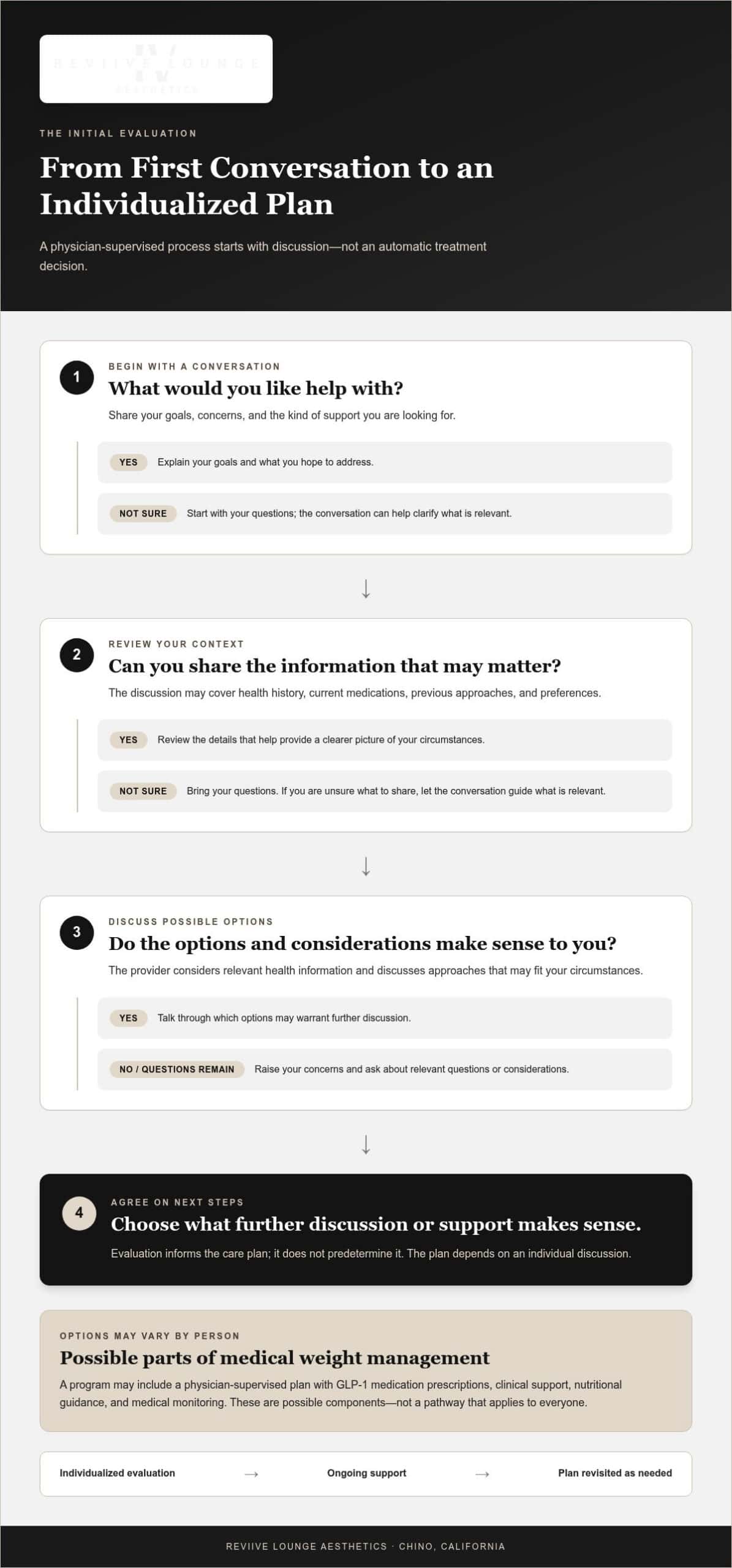
The first step is a conversation, not an automatic treatment decision. If you’re asking how does physician supervised weight loss work, think of the initial evaluation as a chance to clarify your goals, share relevant health context, and discuss possible next steps with a medical professional.
To make the conversation more useful, you can prepare by noting what you want help with, what you’ve tried, and what questions you have. The discussion may follow a straightforward sequence:
- Discuss your goals: Share what you hope to address and what kind of support you’re looking for.
- Review relevant context: Talk about your health history, current medications, previous approaches, and preferences.
- Consider options: Explore approaches that may fit your circumstances, along with relevant questions or considerations.
- Agree on next steps: Decide what further discussion or support makes sense for you.
What May Come Up During an Initial Evaluation?
You may be asked what you’ve tried before, what felt manageable or difficult, and whether you have questions about medical weight management. Sharing current medications and relevant health history can help the provider understand your broader context. You can also bring up preferences, concerns, or practical considerations that could affect which options feel appropriate to discuss.
The evaluation can vary from person to person. It doesn’t necessarily involve the same tests or screening steps for everyone, and this overview can’t determine individual candidacy. If you’re unsure what information to share, start with your questions and let the conversation guide what’s relevant. Bringing a list of current medications and prior approaches can help you give a clear account.
How Does an Evaluation Shape an Individualized Plan?
An evaluation gives the provider context for discussing possible approaches, rather than assigning a predetermined pathway. Your goals and preferences help shape the conversation, while the provider considers relevant health information and explains which options may warrant further discussion. Depending on the individual, the conversation may include nutritional guidance or other medical weight-management options.
The Endocrine Society’s clinical practice guidelines discuss medication as part of care that also includes diet, exercise, and behavioral changes. That broader perspective can help you frame questions about how different approaches might fit together; it doesn’t mean any specific option is right for every patient.
Evaluation informs the care plan; it doesn’t predetermine it. As circumstances and responses become clearer, the plan may be revisited with the provider. At Reviive Lounge, a consultation is an education-first opportunity to discuss your goals and treatment options. You can learn about Reviive Lounge as you consider whether a conversation about individualized medical weight management is a useful next step.
What Role Can GLP-1 Medication Play, and What Should Patients Understand?
GLP-1 medication may come up as one option in a medically guided weight-management discussion. It isn’t automatically appropriate for every person, and considering it doesn’t mean medication becomes the entire plan. If you’re asking how does physician supervised weight loss work, medication decisions are one part of a broader conversation about your goals, health context, and ongoing support.
Is Medication the Whole Program?
No. Medication may be considered alongside other forms of guidance, depending on a person’s circumstances and the plan developed with a qualified provider. Nutritional guidance, activity considerations, and follow-up discussions may also be relevant. The right combination varies, so general information about a medication can’t predict an individual’s results or determine whether it’s suitable.
Ongoing support provides a setting to raise questions and review how a plan fits into daily life. It also keeps the conversation focused on more than whether medication is prescribed. Reviive Lounge’s medical weight-management programs include individualized evaluation and ongoing support, with nutritional guidance and medical monitoring. You can read about medical weight-loss injections as one part of the broader topic.
What Should a Patient Discuss Before Considering Medication?
Bring your questions into the conversation. Sharing relevant health history, current medications, personal goals, and any concerns can help the provider assess which options may be appropriate to discuss. You might ask what potential benefits are being considered, what risks or contraindications apply to your situation, what monitoring may involve, and what support could accompany treatment.
Answers depend on the individual and the medication being considered. Benefits, risks, and precautions should be reviewed with a qualified provider using current, medication-specific information. Regulatory and prescribing details can change, so generalized online claims aren’t a substitute for clinical guidance.
A consultation isn’t a commitment to start medication. It’s an opportunity to understand possible options and trade-offs, share your preferences, and decide on next steps with professional input. Don’t start, change, or stop a prescribed medication based on general information in an article; discuss medication decisions with the clinician responsible for your care.
How Do Follow-Up and Progress Monitoring Support the Process?
A plan isn’t necessarily finished once the first recommendations are made. Follow-up gives you and your provider a chance to discuss how things are going, raise concerns, and consider whether the approach still fits your circumstances. It’s a continuing conversation, not a guarantee of a particular result.
For anyone wondering how does physician supervised weight loss work, ongoing support is a key part of the process. Check-in format and frequency can vary, so there isn’t one schedule or monitoring method that applies to everyone. The purpose is to keep communication open as goals, needs, and experiences become clearer.
What Might a Follow-Up Conversation Cover?
You can share your experience with the plan, revisit your goals, and bring forward questions or concerns. If medication is part of your care, you may discuss how you’re tolerating it and anything you’ve noticed. The provider can consider your individual circumstances and whether it makes sense to revisit options or recommendations. You don’t need to wait for a perfect update to speak honestly about what feels manageable or challenging.
What If the Plan Needs to Change?
Plans can be discussed again as needs or circumstances shift. A change doesn’t mean you’ve failed; it can be an opportunity to talk through what is and isn’t working for you with professional guidance. Share concerns with your provider rather than independently changing a prescribed medication or treatment plan.
Useful monitoring is responsive, not formulaic. A follow-up can help clarify questions and inform a conversation about next steps, but it can’t promise a particular pace or amount of progress. Ongoing support is part of Reviive Lounge’s individualized medical weight-management programs.
Takeaway: Follow-up helps keep a plan responsive to your experience, but it doesn’t guarantee success or a specific outcome. To explore medical weight-management support and discuss your goals, learn about a consultation at Reviive Lounge.
How to Explore Physician-Supervised Weight Loss at Reviive Lounge in Chino
For readers in Chino and the surrounding Inland Empire, Reviive Lounge offers physician-led medical weight-management programs built around individualized evaluation and ongoing support. A consultation is a place to discuss your goals, questions, and possible options, not a promise that a particular treatment or medication will be recommended.
If you’ve been asking how does physician supervised weight loss work, a conversation with a provider can help make the process more specific to your situation. You can learn about the medical weight-management program and discuss which treatment options may be appropriate based on your individual circumstances.
What Can I Bring to a Weight-Management Consultation?
A little preparation can help you make the most of the discussion. Consider noting:
- Your personal goals and what kind of support you’re looking for.
- Relevant health history and any current medications.
- Approaches you’ve tried before and what you learned from them.
- Questions or concerns about potential treatment options and follow-up.
These details give the provider helpful context for a more personalized conversation. You don’t need to have every answer prepared. The consultation can help clarify what matters to you and what further discussion may be useful; it doesn’t guarantee eligibility for a program or a specific treatment.
How Can Chino-Area Readers Take a Thoughtful Next Step?
Reviive Lounge is located in Chino, California, offering a local option for people in the surrounding Inland Empire who want to explore medically guided weight management. The discussion can include your goals, relevant health context, questions about candidacy, and treatment options, with room to understand the choices before deciding on next steps.
There’s no need to arrive with a predetermined plan. Bring your questions, share what you’re hoping to address, and use the consultation to understand whether an individualized approach feels right for you. Reviive Lounge serves people from nearby communities including Norco, Corona, Chino Hills, Rancho Cucamonga, Ontario, Eastvale, Pomona, La Verne, Upland, and Fontana. If you’re ready to explore your options, you can schedule a consultation with Reviive Lounge in Chino.
Take Your Next Step Toward Personalized Weight Management
Understanding how does physician supervised weight loss work begins with recognizing that care is more than a prescription. An individualized evaluation helps guide the discussion, medication may be one option rather than the whole plan, and ongoing support gives you and your provider a chance to revisit questions and changing needs.
There’s no single pathway or guaranteed outcome. Your goals, health context, and preferences matter when deciding which options are appropriate to discuss. A consultation can help you understand those options and make an informed choice at your own pace.
Reviive Lounge is a physician-led medical aesthetics and wellness practice in Chino, California. Its medical weight-management programs include individualized evaluation and ongoing support, with clinical support, nutritional guidance, and medical monitoring. Schedule a consultation at Reviive Lounge to discuss your goals and treatment options.
Frequently Asked Questions
How does physician-supervised weight loss work?
It generally begins with an individualized conversation about your goals and relevant health context. A provider can use that discussion to explain possible approaches, including whether medication may be worth considering and what support could involve. The answer to how does physician supervised weight loss work depends on the person: plans and follow-up aren’t identical for everyone. Use a consultation to discuss candidacy, questions, and potential risks.
What happens at the first physician-supervised weight-loss appointment?
An initial appointment may cover your goals, relevant health history, current medications, and approaches you’ve tried before. This information can help the provider explain potential next steps and whether additional evaluation may be appropriate. The process varies by person, so there isn’t one required checklist for every visit. Bring your questions and an accurate medication list, and don’t change prescriptions without guidance from your prescriber.
Is physician-supervised weight loss only medication?
No. Medication may be discussed as one possible component, but medical weight management can also include individualized evaluation, guidance, and ongoing support. Which elements make sense depends on your circumstances and the provider’s assessment. Don’t assume a particular medication or plan will be recommended. A consultation can help clarify the options, relevant considerations, and what follow-up may look like for you.
Who may be a candidate for medically supervised weight management?
Candidacy depends on individual health circumstances, goals, medical history, and the options being considered. An online checklist or general article can’t determine whether a treatment is suitable for you. A qualified provider can discuss potential benefits, risks, and alternatives during an individualized evaluation. Reviive Lounge is located in Chino, California, for readers exploring options from Norco, Corona, Chino Hills, Rancho Cucamonga, Ontario, Eastvale, Pomona, La Verne, Upland, and Fontana.
Are GLP-1 medications required in a physician-supervised weight-loss program?
No. GLP-1 medication may be discussed as one option, but no particular treatment should be assumed to be required or appropriate for everyone. Suitability depends on an individual evaluation and a conversation about potential benefits and risks. Programs and care plans can differ. Ask your provider how options are considered, and don’t start, stop, or adjust prescribed medication without medical guidance.
How often are follow-up appointments needed during medical weight management?
Follow-up timing varies according to your circumstances, the plan, and the provider’s approach. Check-ins may offer a chance to discuss your experience, progress, concerns, and whether next steps should be reconsidered. A schedule used by another clinic may not apply to your care. During your consultation, ask what ongoing support may look like for your individual plan.
Does physician-supervised weight loss guarantee results?
No. Medical guidance can support individualized decision-making, but it can’t guarantee a particular amount, pace, or duration of weight loss. People’s experiences and responses vary, and treatment options may involve considerations to review with a qualified provider. Focus on understanding the proposed plan, asking questions, and sharing concerns. Reviive Lounge’s medical weight-management programs include individualized evaluation and ongoing support, without promising a specific outcome.