


For people in Upland considering tirzepatide injections for weight loss, Reviive Lounge Aesthetics in nearby Chino offers consultations about medically supervised weight-management options. Eligibility may include adults with a BMI of 30 or higher, or a BMI of 27 or higher with at least one weight-related condition. A clinician-guided assessment helps determine whether this approach fits your health profile and goals.
It’s reasonable to want clear information before considering an injectable medication. Tirzepatide acts on hormones involved in appetite and insulin regulation. Whether it fits into weight management depends on individual health factors, not a one-size-fits-all approach.
This article explains what tirzepatide is, how it may support weight management, what factors shape eligibility, and what to discuss during a consultation and ongoing care if you live in Upland.
Key Takeaways
- Understand tirzepatide’s role in medically supervised weight management and how it differs from a general lifestyle approach.
- Learn how appetite and insulin-related hormone activity can influence hunger, fullness, and blood sugar.
- See how a personalized consultation considers health history, weight-related conditions, and treatment suitability.
- Explore how clinician-guided care can combine medication with lifestyle coaching, nutritional guidance, and regular check-ins.
- Get a clearer picture of the questions to consider before beginning treatment and what ongoing support may involve.
Why Choose Tirzepatide for Weight Loss in Upland, CA?
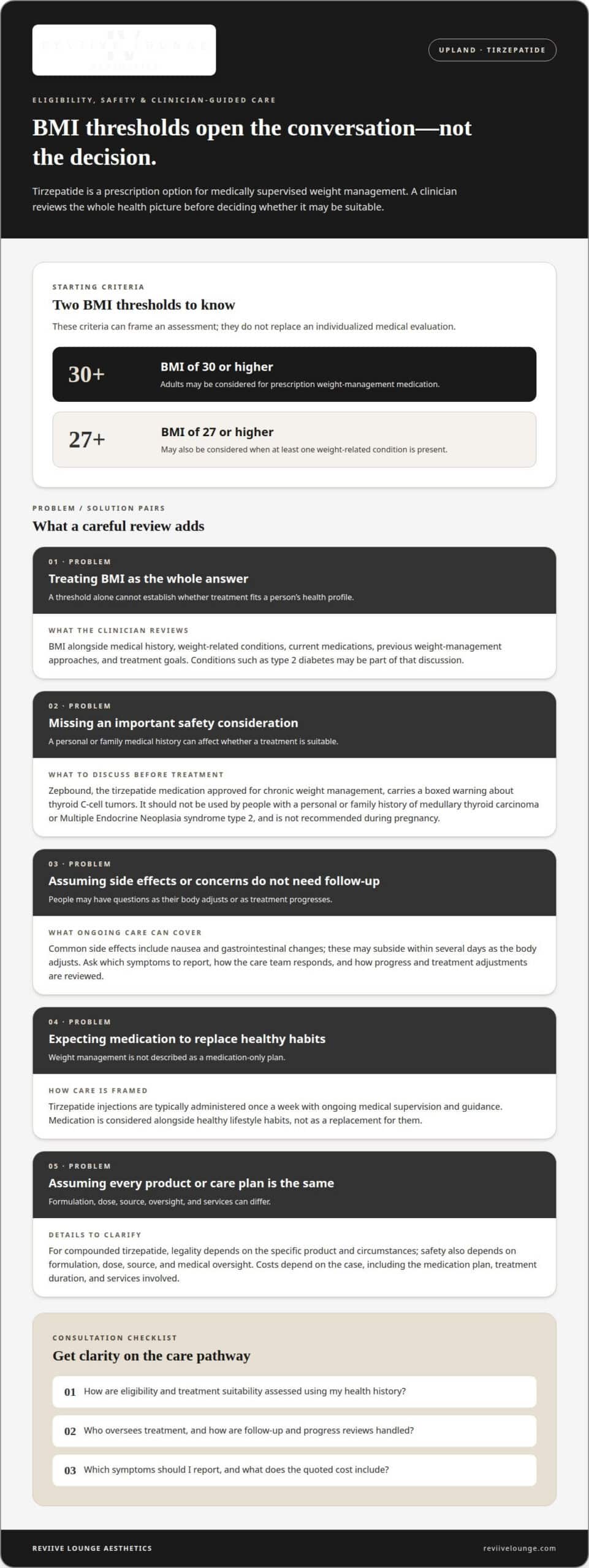
Tirzepatide is a prescription option for adults seeking medically supervised weight management. Eligibility is assessed using body mass index (BMI), health history, weight-related conditions, and treatment goals. Many prescription weight-management medications may be FDA-approved for adults with a BMI of 30 or higher. Adults with a BMI of 27 or higher and at least one weight-related condition may also qualify under medication criteria.
A BMI threshold is a starting point, not a complete medical evaluation. A clinician considers conditions such as type 2 diabetes, other medications, previous weight-management approaches, and factors that could affect treatment suitability. For example, someone meeting the BMI threshold may still need an individualized review of their medical history before a treatment plan is recommended.
Before starting, an evaluation can cover current health concerns, medication use, and personal or family history relevant to safety. Zepbound, the tirzepatide medication approved for chronic weight management, carries a boxed warning about thyroid C-cell tumors. It should not be used by people with a personal or family history of medullary thyroid carcinoma or Multiple Endocrine Neoplasia syndrome type 2; it is also not recommended during pregnancy.
Common side effects include nausea and gastrointestinal changes. These may subside within several days as the body adjusts. The thyroid C-cell tumor warning is a serious risk to discuss during an evaluation, along with medical-history concerns that could affect suitability.
There isn’t one yes-or-no answer about compounded tirzepatide: legality depends on the specific product and circumstances. Safety also depends on formulation, dose, source, and medical oversight. Ask the clinician to explain the preparation under consideration.
When comparing care options, focus on the process rather than promised progress. Ask how eligibility is assessed, who oversees treatment, how medication and follow-up are handled, and which side effects need attention. A clear explanation should cover how your health history informs the plan and how progress is reviewed.
Tirzepatide injections are typically administered once a week, with ongoing medical supervision and guidance supporting treatment. Medication is considered alongside healthy lifestyle habits, not as a replacement for them. For details about weight-loss injections, learn how consultation and eligibility fit into a medically supervised approach.
Personalized consultation and treatment eligibility
For Upland residents, a consultation can consider BMI criteria alongside medical history, weight-related conditions, and treatment goals. It should also explain how follow-up and progress reviews fit into care.
Personalized Consultation and Candidacy
A personalized consultation considers more than a BMI reading. The clinician reviews your medical history, current medications, health conditions, previous weight-management efforts, and goals. This information helps determine whether tirzepatide may be suitable and what questions to address before treatment begins.
Ask how follow-up care works, which measures of progress will be reviewed, and how treatment may be adjusted over time. A clinician can explain tirzepatide’s role as a peptide medication and its effects on appetite and insulin regulation. If glucagon comes up in a discussion of hormone activity, ask how it relates to the medication being considered.
BMI-Based Treatment Criteria
BMI is one part of the candidacy assessment. Adults with a BMI of 30 or higher may be considered for prescription weight-management medication. Adults with a BMI of 27 or higher may also be considered when at least one weight-related condition is present.
These thresholds help frame the evaluation; they don’t replace a review of overall health. A clinician weighs the BMI alongside conditions, medical history, medications, and treatment goals. For example, a person at the 27 threshold needs a qualifying weight-related condition considered as part of candidacy.
For Upland-area patients visiting the Chino practice, the consultation is an opportunity to understand the treatment pathway before making a decision. Discuss how medication administration is arranged, how often check-ins occur, and which changes in health or progress might prompt a treatment adjustment. Follow-up gives the clinician a chance to review how the plan is working and address concerns as they arise.
Ask how the plan accounts for appetite changes, your medical history, and other treatments you use. Find out which symptoms to report and how the care team responds to side effects. Clear answers help you understand the recommended approach and support involved, without relying on general promises about results.
Costs depend on the case and are given after a quote request; factors include the medication plan, treatment duration, and services involved. Discuss payment arrangements during the consultation, including what the quoted amount covers. To explore the consultation process for weight-loss injections, consider how eligibility, follow-up, and treatment adjustments fit your needs.
Clinician-guided tirzepatide for weight management
Clinician-guided care connects medication decisions with health history, treatment goals, and follow-up. In Upland, the appointment process should clarify how assessment, access, and progress reviews fit together.
Clinical-Trial Weight-Loss Outcomes
Clinical-trial results offer context, not a prediction for an individual patient. In the larger of two trials behind the FDA’s 2023 approval of tirzepatide, adults without diabetes taking the highest approved dose lost an average of 18% of their body weight over 72 weeks.
That finding applies to a specific study group, dose, and timeframe. A clinician can explain how factors such as diabetes, medical history, and treatment tolerance may differ from the trial conditions.
FDA-Approved Zepbound Availability
Zepbound is the tirzepatide medication approved in 2023 for chronic weight management in adults. In Upland, look for a medical weight-loss clinic that assesses candidacy and discusses whether Zepbound suits your health profile.
An evaluation should cover medical history, treatment goals, and ongoing monitoring. A brand name alone does not establish whether someone is eligible or whether treatment is appropriate.
Clinician guidance matters because tirzepatide affects hormones involved in appetite and insulin regulation. For patients with type 2 diabetes, the clinician weighs diabetes management alongside weight goals and other medications. This review helps distinguish weight-management planning from diabetes care alone.
Access to care involves more than arranging an injection. The pathway includes a consultation, an assessment of suitability, and follow-up to review progress and discuss possible adjustments. Ask how check-ins are arranged, who reviews health changes, and how questions are handled between visits.
Trial outcomes also need careful interpretation. The 18% average reported over 72 weeks came from adults without diabetes taking the highest approved dose in one trial. It doesn’t describe every dose, patient group, or treatment duration, so use it as study context rather than a personal target.
For treatment costs, the amount depends on the case and is provided after a quote request. Cost factors include the medication plan, treatment duration, and services involved. Ask what the estimate covers, including follow-up, so the financial picture is clear before treatment starts.
Before booking, prepare a concise account of your medical history, current medicines, diabetes status, and previous weight-management approaches. This gives the clinician a useful starting point for discussing whether Zepbound may be suitable and how progress would be assessed.
How semaglutide and tirzepatide work
Semaglutide and tirzepatide affect hormone signals connected with appetite, digestion, and blood sugar. Understanding their differences can help clarify how each medication may fit into weight management.
How Tirzepatide Works
Tirzepatide mimics hormones involved in regulating appetite and insulin levels. Those signals can help manage hunger and caloric intake, while also affecting blood sugar. This connection matters for people with type 2 diabetes and for weight-management planning. A clinician considers the medication’s effects alongside health needs and treatment goals.
GLP-1 medications can help people feel full longer and slow stomach emptying. These effects may change how hunger and meal fullness feel during treatment. Tirzepatide may also improve blood sugar levels and reduce food cravings. It’s a prescription treatment, not a complete loss solution on its own; lifestyle habits remain part of weight management.
Comparing the Two Medications
Semaglutide and tirzepatide both act on hormone pathways related to appetite and blood sugar, but they aren’t the same medication. Semaglutide mimics a naturally occurring GLP-1 hormone. Tirzepatide mimics certain hormones involved in appetite and insulin regulation. A clinician considers these distinctions when discussing treatment options.
Semaglutide has been used in clinical treatments since 2005. In a review of four randomized trials, adults with obesity but without diabetes who took semaglutide lost about 12% more of their body weight on average than those taking placebo. That comparison describes a group-level result, not an individual outcome.
Both medications influence digestion as well as appetite. Slower stomach emptying and longer-lasting fullness can affect meal patterns, while blood-sugar effects are relevant to metabolic health. These mechanisms help explain why treatment discussions may include weight goals and conditions such as diabetes.
Trial findings need context. The semaglutide review compared participants with placebo across four randomized trials and focused on adults with obesity who did not have diabetes. Its average result is not a personal forecast or a direct comparison with tirzepatide, because the figures describe different evidence.
Neither medication works as an isolated strategy for everyone. GLP-1 medications can support weight loss when combined with a healthy lifestyle, and a clinician-guided plan can consider nutrition, activity, appetite changes, and treatment response together. This broader view helps distinguish a medication’s role from the full work of managing obesity.
For a practical comparison, discuss the treatment goal, diabetes status, medical history, appetite concerns, and how progress will be reviewed. These factors help frame whether semaglutide or tirzepatide is under consideration and its possible role in an individualized weight-management plan.
GLP-1 weight-loss program in Upland
A GLP-1 program pairs medication with structured clinical support, rather than treating injections as a stand-alone solution. For Upland residents, its value lies in connecting weekly treatment with nutrition guidance, lifestyle coaching, and regular progress reviews.
Semaglutide and tirzepatide injections are typically administered once a week. A program may begin with a 12-week treatment period, giving the care team time to review tolerance, appetite changes, and early progress. The length and structure of care help make each check-in useful: patients can discuss what feels manageable and where the plan needs attention.
Medication doses are generally increased gradually over several months until patients reach their target dose. This paced approach allows adjustments to be considered in light of an individual’s response. During check-ins, discuss concerns such as nausea, changing cravings, or difficulty following nutrition guidance, rather than relying on a dose increase alone to address every challenge.
Support can extend beyond medication. Lifestyle coaching and nutritional guidance can help turn appetite changes into practical routines, such as planning satisfying meals and maintaining consistent habits. Regular check-ins create opportunities to review those routines and progress. A personalized wellness plan considers how medication, food choices, activity, and individual health needs fit together.
Timing varies from person to person. Some patients may notice effects within the first month of tirzepatide treatment, while gradual weight loss may begin four to eight weeks after starting. These milestones can inform progress discussions, but the care team also considers treatment tolerance and changes in habits, not only the scale.
An in-office tirzepatide injection often takes less than 10 minutes. That brief administration is only one part of the program; consultation, follow-up, and dose reviews support the broader treatment process. For Upland residents arranging care, ask how appointments and ongoing check-ins are coordinated, and how the team handles questions between visits.
Insurance matters when planning treatment. The clinic’s current policy is that insurance isn’t accepted for weight-loss treatments, so patients should discuss the payment arrangements and what the program includes before beginning. No medication plan should be treated as a guaranteed outcome; individual response and treatment decisions vary.
Consider whether a 12-week program’s coaching, nutritional guidance, and check-ins match the support you want. A clinician can explain how tirzepatide or semaglutide may fit your health profile and how progress informs treatment adjustments. Explore physician-supervised weight-loss injections to understand the care pathway and begin a treatment discussion.
Reviive Lounge Aesthetics: Botox & Neurotoxin Injections
Reviive Lounge Aesthetics offers physician-supervised Medical Weight Loss Programs with GLP-1 medications, giving Upland residents a local next step after learning how tirzepatide may support weight management. A consultation can connect your health history and goals with an individualized discussion of treatment suitability and ongoing care.
Consider a medically supervised weight-management plan when you’re ready to discuss whether it fits your needs. Botox & Neurotoxin Injections are a separate aesthetic service, not part of tirzepatide treatment.
Contact Reviive Lounge Aesthetics to discuss medical weight management and your next steps.
Take the Next Step Toward a Personalized Plan
Choosing a weight-management approach is also an opportunity to define what meaningful progress looks like in daily life. Before a consultation, consider the habits you want to build, the support that could help you sustain them, and the questions you want answered. These priorities can make the conversation more focused and useful.
If you’re considering tirzepatide injections for weight loss in Upland, use a consultation to explore how treatment might fit your health goals and routine. A thoughtful plan gives you space to understand the approach, discuss concerns, and make an informed decision without pressure.
Contact Reviive Lounge Aesthetics to begin a conversation about your goals and possible next steps. Your path forward can start with a clear, personalized discussion.
Frequently Asked Questions
What is Tirzepatide?
Tirzepatide is a prescription medication that acts on hormone pathways involved in appetite and insulin regulation. By influencing these signals, it may help manage hunger and caloric intake as part of medically supervised weight management. Zepbound is the tirzepatide medication approved for chronic weight management in adults. Whether it fits your situation depends on your health profile, treatment goals, and a clinician’s evaluation.
What if I miss a dose?
If you miss a dose, follow the instructions for your prescribed medication and contact the clinician overseeing your treatment for guidance. Don’t take an extra dose or change your injection schedule based on guesswork. The right next step can depend on your prescription and timing, so share when the dose was due and when you noticed it was missed.
Are there any dietary restrictions while on GLP-1s?
There isn’t one meal plan that suits every person using a GLP-1 medication. Follow the nutritional guidance in your treatment plan, and discuss food preferences, allergies, or routines that affect meals with your clinician. If appetite changes or nausea make eating difficult, bring specific examples, such as which meals are challenging, to a check-in so your care team can guide adjustments.
Can my tirzepatide treatment be combined with another procedure?
Combining tirzepatide treatment with another procedure requires an individualized review; don’t assume the combination is appropriate. Before a procedure, tell the clinicians involved about your medication and dose schedule. For example, share this information when discussing an aesthetic service such as dermal fillers or microneedling with PRP. The medical team can consider your health history and timing before advising on next steps.
How long is the typical treatment course with semaglutide or tirzepatide?
A 12-week program is typically recommended as a starting point for semaglutide or tirzepatide treatment. That starting program isn’t a promise that medication will stop at its end; ongoing care and treatment decisions depend on clinical review, response, and individual goals. Use check-ins to discuss progress, tolerability, and whether the plan should continue or change.
How soon can I expect results after starting my tirzepatide treatment?
Some patients may notice effects within the first month of tirzepatide treatment. Early changes can include differences in appetite, while changes in weight may take longer to become apparent. Track what you notice and discuss it during follow-up rather than judging treatment by a single day or meal. Individual responses and treatment adjustments shape progress.
How soon will I lose weight?
Gradual weight loss may begin four to eight weeks after starting treatment, though timing varies. Appetite changes may appear before visible weight changes. Note patterns over time, including appetite, eating routines, and progress between check-ins. A clinician can interpret those details in the context of your treatment plan rather than relying on one measurement alone.
Where can Upland-area patients ask about tirzepatide weight-loss treatment?
Upland residents can discuss physician-supervised medical weight management with Reviive Lounge Aesthetics, located in Chino and serving surrounding Inland Empire communities. The practice offers Medical Weight Loss Programs with GLP-1 medications. An appointment provides an opportunity to discuss your medical history, goals, and whether treatment is suitable. The practice is at 12598 Central Ave, Suite 104, Chino, CA 91710.