

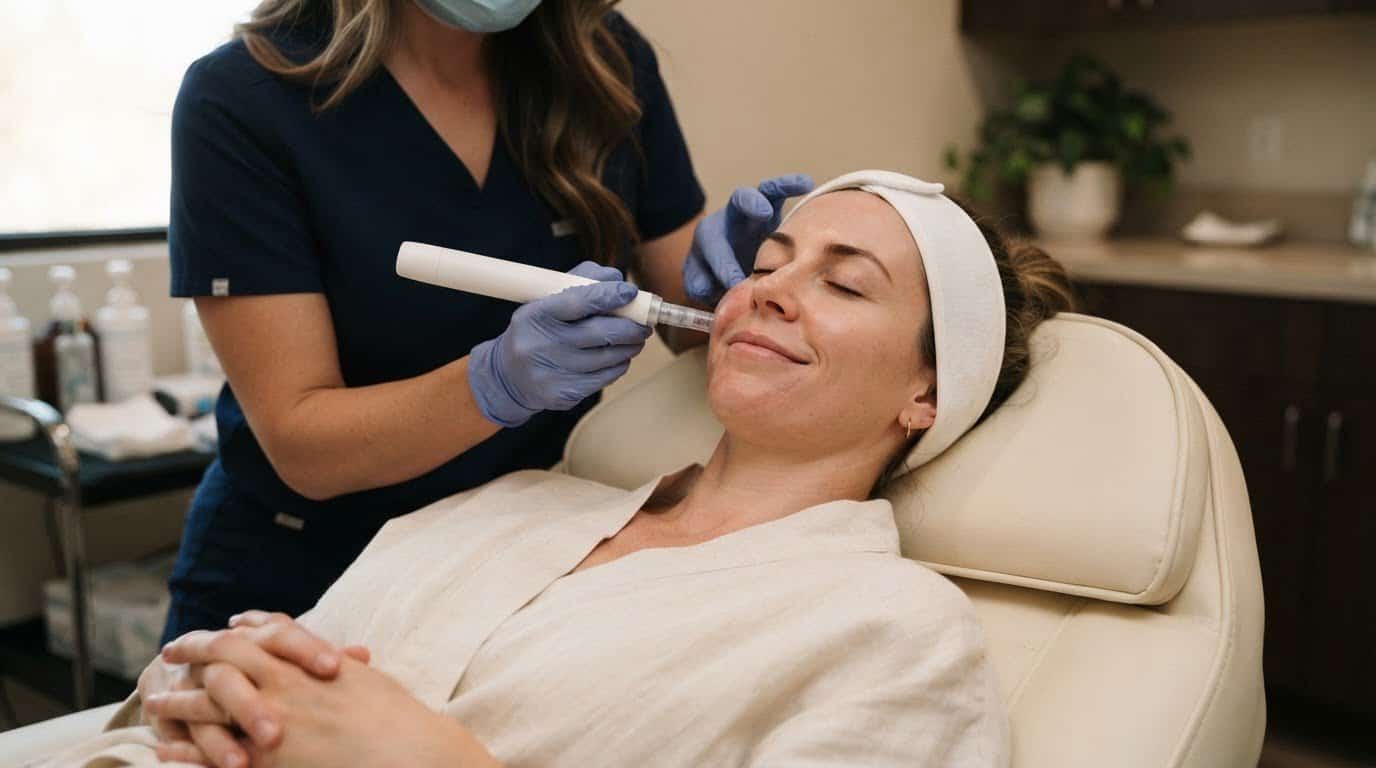
SkinPen microneedling can help improve the appearance of uneven texture, tone, and acne scars by prompting the skin’s collagen and elastin response. A session lasts approximately 30 minutes, and the benefits of SkinPen microneedling may develop gradually as the skin responds to treatment.
It makes sense to want more than a smoother-looking surface, especially when acne scars or lingering unevenness affect how your skin feels to you. This guide explains how SkinPen works, what it may do for texture, tone, and visible acne scars, and what to expect from a treatment series. It also explores how SkinPen may be combined with PRP or PRF, so you can better understand the options and the factors that shape a personalized approach.
Key Takeaways
- Understand how SkinPen’s controlled micro-injuries support the skin’s collagen and elastin response.
- See how treatment planning can be tailored to skin type, concerns, and treatment area.
- Learn what SkinPen may do for rough texture, uneven tone, and the appearance of acne scars.
- Explore why a series of treatments may be recommended and how results can continue to develop afterward.
- Discover how SkinPen may be paired with PRP or PRF, and what to consider when comparing these options.
What Is SkinPen Microneedling?
SkinPen microneedling uses fine needles to create controlled micro-injuries in the skin. As the skin repairs itself, this process stimulates collagen production and elastin activity. SkinPen is FDA-cleared to improve the appearance of acne scars. Other potential benefits of SkinPen microneedling include smoother-looking texture and softer-looking fine lines.
Unlike invasive procedures, SkinPen works through precise mechanical stimulation. It doesn’t use heat, light, or thermal energy. Its approach also differs from laser resurfacing: SkinPen creates microscopic punctures, while a laser uses light-based energy. The right option depends on your skin concern and the treatment approach being considered.
SkinPen can be used on the face, neck, chest, and décolleté. For example, a treatment plan may focus on acne scars across the cheeks or fine lines on the neck. The treatment depth and protocol can be adjusted to the area and concern, rather than using one setting across the entire treatment area.
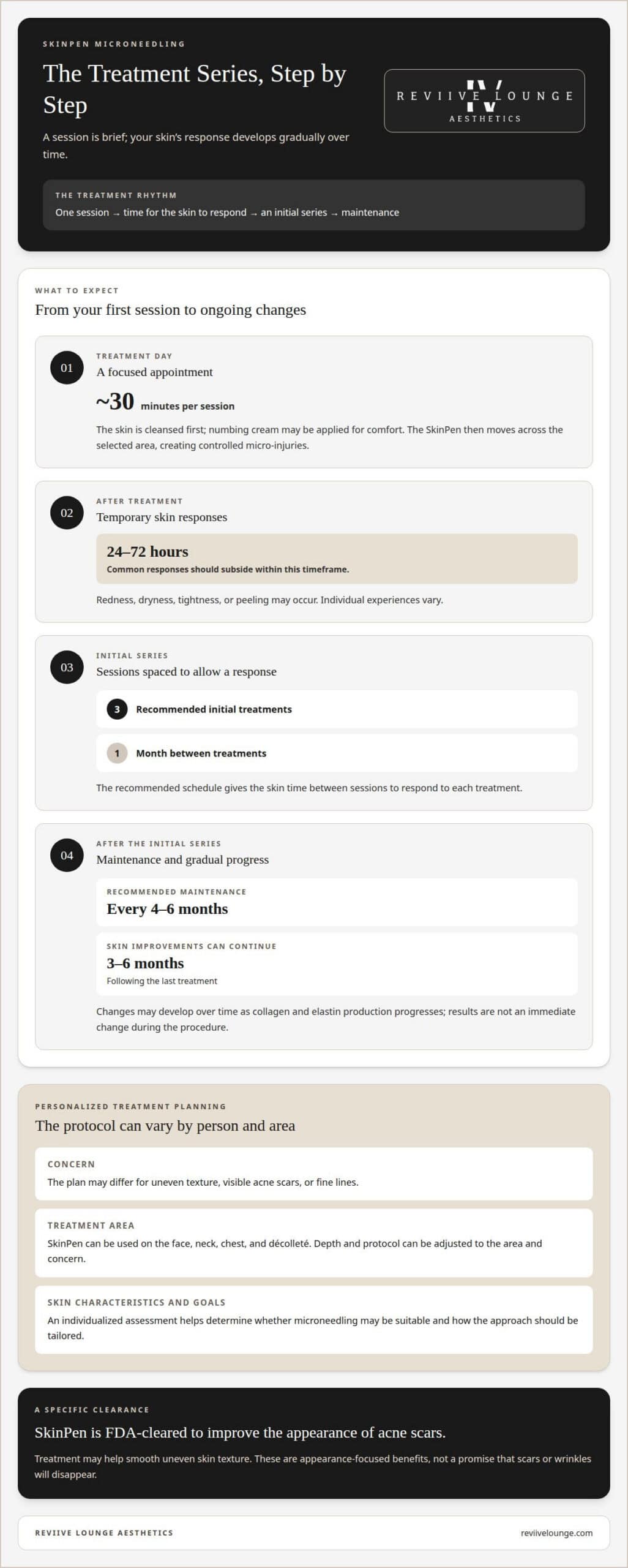
A session lasts approximately 30 minutes. Before treatment, the skin is cleansed, and numbing cream may be applied for comfort. During the procedure, the device moves across the selected area to create controlled micro-injuries. Afterwards, redness, dryness, tightness, or peeling may occur; these common responses should subside within 24 to 72 hours. This temporary downtime is part of the skin’s response, though individual experiences vary.
A recommended initial series consists of 3 treatments, spaced 1 month apart. This schedule gives the skin time between sessions to respond to each treatment. Maintenance treatments are recommended every 4-6 months after the initial series. Skin improvements can continue for three to six months following the last treatment, as collagen and elastin production progresses.
For acne scars, SkinPen is FDA-cleared to improve their appearance, and treatment may help smooth uneven skin texture. It may also soften the appearance of neck wrinkles by supporting collagen production. These are appearance-focused benefits, not a promise that scars or wrinkles will disappear. SkinPen’s FDA clearance specifically covers improvement in the appearance of acne scars.
In the United States, the price depends on the treatment area, treatment plan, and whether add-ons are included; the cost is provided after a quote request. That means a plan for the face alone may differ from one that also addresses the neck or chest.
Is it safe for any skin type?
SkinPen treatment can be tailored to a person’s skin type and concerns. The device uses mechanical microneedling rather than pigment-targeting technology, which is one reason it may be considered for a broad range of skin tones. Suitability still depends on your skin and treatment goals, so an individualized assessment is important.
Skin tone and skin type describe different features. Tone refers to the amount and distribution of pigment, while skin type can include characteristics such as oiliness, dryness, and sensitivity. For example, two people with similar skin tones may have different concerns and need different treatment approaches. The clinician can tailor the protocol to those differences rather than using an identical approach for everyone.
Microneedling works through controlled micro-injuries that activate the skin’s repair response. As the skin responds, collagen production and elastin activity support its structure and flexibility. Collagen contributes to firmness, while elastin helps skin stretch and return toward its resting shape. These processes develop over time, rather than creating an immediate change during the procedure.
Collagen and elastin stimulation is the biological rationale behind microneedling. A carefully selected treatment depth creates a repair signal without relying on heat, light, or thermal energy. This distinction may matter to people concerned about pigment changes, since SkinPen doesn’t use light-based energy to target pigment. It doesn’t mean every skin concern responds the same way; the area and skin characteristics guide the protocol.
When planning treatment, the clinician considers your concern, the treatment area, and how your skin presents. A plan for uneven texture, for instance, may differ from one addressing visible acne scars or fine lines. The depth and protocol can be customized to target the concern while accounting for the surrounding skin. Adjustable settings support an individualized approach, but don’t guarantee identical responses.
Safety depends on appropriate treatment selection and technique. A qualified provider assesses whether your skin’s condition and goals make microneedling a suitable option, then tailors the approach. SkinPen may be considered for many skin tones, but this does not mean it is appropriate for every person at every time. Skin condition, treatment area, and goals all shape a personalized plan.
After treatment, the skin’s repair activity continues, and collagen and elastin production may contribute to gradual changes in firmness and texture. Because this response unfolds over time, the immediate appearance isn’t the full picture. An individualized assessment of your skin type, concern, and treatment area helps determine whether SkinPen may be appropriate for you.
Skin texture and tone
SkinPen may improve the appearance of rough texture, enlarged pores, uneven tone, and sun damage. Its mechanical approach creates controlled micro-injuries rather than targeting pigment with light. That distinction may matter when skin tone is a consideration. Treatment depth and protocol are tailored to your skin and concern, rather than automatically using the same approach for everyone.
A session can be part of a plan to improve texture, and a treatment series may build on the skin’s response over time. Changes are gradual, not an instant resurfacing effect. For example, someone concerned about roughness across the cheeks may notice a smoother feel as the skin heals. Treatment may also improve the appearance of dark spots, but it isn’t a way to remove every area of discoloration.
Skin tone and skin type are separate considerations. SkinPen doesn’t rely on pigment-targeting technology and is generally considered suitable for nearly all skin tones and types when performed by a qualified provider. Skin type can include characteristics such as sensitivity or oiliness, while tone concerns visible pigmentation. The selected treatment depth and area help shape a more tailored session.
Timing can help set expectations. Some patients may notice smaller-looking pores and renewed firmness about a week after treatment. Fine lines may soften, pores may appear smaller, and tone may look more even by weeks 2-4. These are possible visible changes, not a promise that every person will experience each one on the same schedule.
The healing process can temporarily affect how texture and tone look. Redness, dryness, tightness, or peeling may occur after treatment and should subside within 24 to 72 hours. During this period, the skin may look less even before it settles. The temporary response is different from the longer-term changes the treatment aims to support.
For uneven tone, the pattern of the concern matters. Scattered dark spots, sun-damaged areas, and roughness may call for different planning than enlarged pores alone. A qualified provider considers your skin’s current condition, tone, and treatment area before choosing a protocol. This helps align the session with your concern rather than treating every discoloration as the same issue.
SkinPen’s potential benefits for texture and tone come from controlled stimulation and the skin’s subsequent repair response. Results can develop over the first few weeks, with improvements continuing after a session as the skin heals. People with different skin tones may be candidates, but suitability still depends on skin condition and the specific concern being treated.
Acne scars
SkinPen is FDA-cleared to improve the appearance of acne scars. Its controlled needle injuries prompt a natural healing response, which may support smoother-looking skin over time.
Improving Acne Scar Appearance
Improving the appearance of acne scars means addressing visible unevenness in the skin’s surface, not promising to erase scars. SkinPen creates microscopic injuries that activate collagen production during natural healing. For someone whose cheeks look uneven after acne, the goal may be a more refined appearance as the skin responds. Changes develop gradually, so the immediate post-treatment look isn’t the final outcome.
Acne and Surgical Scar Reduction
SkinPen is FDA-cleared to improve the appearance of acne scars, but that clearance does not extend to surgical scars. This distinction helps set realistic expectations: acne-related texture is the supported focus here, while a surgical scar is a different concern. A provider considers the scar’s appearance and location when discussing treatment, rather than assuming one approach suits every mark.
The device’s needles create controlled micro-injuries in the treated skin. This triggers a repair process that supports collagen production, which may help soften the look of uneven acne-scar texture. The aim is gradual improvement in appearance, not removal of the scar itself. Results depend on how your skin responds over time.
Acne scars can appear alongside fine lines or wrinkles, but these are different concerns. SkinPen may also diminish the appearance of fine lines and wrinkles by promoting collagen production. A treatment plan can distinguish between scar texture and fine lines, then tailor the protocol to the area being addressed. This keeps the goal specific instead of treating every visible line as a scar.
After a session, redness, dryness, tightness, or peeling can occur as the skin heals. These common responses should subside within 24 to 72 hours. The temporary surface changes are distinct from the slower collagen response that supports the intended improvement. Understanding that difference helps explain why the skin’s appearance right after treatment doesn’t show the full result.
SkinPen’s FDA clearance supports its use for improving the appearance of acne scars, but it doesn’t guarantee that every scar will look the same afterward. The clinician can customize the treatment depth and protocol. For example, the approach may be adjusted to the area and concern, with the aim of smoothing uneven texture while supporting the skin’s natural healing response.
Combining SkinPen with PRP or PRF
Pairing SkinPen with a platelet-based option adds another element to a microneedling session. PRP, or platelet-rich plasma, may be applied to the face during treatment. PRF, or platelet-rich fibrin, is another option people may encounter, but the available details here do not establish that it produces better results. The practical takeaway: understand what is being added and what outcome the treatment aims to address.
SkinPen’s device creates controlled micro-injuries that trigger the skin’s repair response. In a PRP session, topical numbing cream is applied first, and numbing takes about half an hour. The PRP is then applied during microneedling. A full PRP SkinPen session generally takes about one hour, which includes preparation and treatment rather than just the device passing over the skin.
Timing can help with planning. PRP SkinPen treatments are typically scheduled four to six weeks apart. Patients may notice changes within a week, while the most dramatic results are described as visible after 4 to 8 weeks. These milestones refer to different stages, not a guarantee that every person will see the same changes on an identical schedule.
Redness and tenderness can follow a PRP SkinPen session. Downtime is described as 24 to 72 hours, and those effects typically clear within 2 to 4 days. Some patients heal within 24 hours, but that shorter experience doesn’t define everyone’s recovery. Plan around the expected healing window, especially if an event or close-up photography is coming up.
PRF deserves a careful comparison rather than an assumption of equivalence. The treatment name refers to platelet-rich fibrin, but the available treatment details describe PRP with SkinPen, not a specific PRF protocol, timing, or result. Ask what the add-on involves and how it aligns with your skin concern. The important distinction is between a documented PRP treatment process and a PRF option whose details may vary.
SkinPen is FDA-cleared to improve the appearance of acne scars. That clearance applies to the device’s use for that appearance concern; it does not establish that adding PRP or PRF improves the outcome beyond SkinPen alone. A combined approach should have a clear rationale, such as pairing microneedling with an applied PRP add-on, rather than relying on broad claims about enhanced healing.
For a personalized discussion of SkinPen with PRP, explore SkinPen microneedling options and consider how your skin goals, recovery window, and preferred add-on fit together. PRP has described timing and recovery expectations; PRF should be evaluated according to the specific protocol being proposed.
Reviive Lounge Aesthetics: Skin Care
Reviive Lounge Aesthetics offers SkinPen microneedling and microneedling with PRP for people exploring options for uneven texture or visible acne scars. A personalized discussion can help connect your skin concern with the treatment approach, including whether adding PRP fits your goals. The practice also offers skin care, Botox and neurotoxin injections, and dermal fillers, which address different aesthetic concerns.
When you’re ready to discuss your priorities and treatment options, schedule a consultation at Reviive Lounge in Chino. The team can help you explore an individualized plan.
Choose a Skin Plan That Fits Your Goals
Your next step can start with identifying the change that matters most to you, such as softer-looking acne scars or smoother texture. The benefits of SkinPen microneedling are best considered alongside your skin goals, healing preferences, and whether a PRP add-on belongs in the discussion. Your skin’s response and the most suitable approach depend on your individual concerns.
A focused conversation can help turn those priorities into a clear treatment plan, without assuming that every option is right for every person. Reviive Lounge Aesthetics offers SkinPen microneedling and microneedling with PRP as options to discuss. Explore your next step with Reviive Lounge Aesthetics, and move forward with a plan that feels considered and personal.
Frequently Asked Questions
SkinPen Results: When Are They Visible?
Early changes can appear before the full response develops. Skin may look smoother or have a subtle glow within the first week, while collagen-related improvements can continue for months after a treatment series. For a useful comparison, consider the same areas and lighting when observing your skin over time. A single early snapshot may not reflect the gradual changes that follow microneedling.
Does the Procedure Hurt?
SkinPen can cause mild discomfort, and topical numbing cream may be applied beforehand to reduce it. Some patients describe feeling slight vibration during treatment. Sensation can differ across areas, so the cheeks, forehead, or neck may not feel the same during a session. The clinician can tailor the approach to the area and your comfort needs.
How Does SkinPen Work?
SkinPen uses sterile needles to create controlled microscopic openings in the skin, prompting a repair response that supports collagen and elastin production. The device works mechanically rather than using heat, light, or thermal energy. This process aims to improve the appearance of concerns such as uneven texture and acne scars. A clinician adjusts the treatment depth and protocol to the area and concern.
How Long Does a Treatment Take?
A SkinPen treatment takes approximately 30 minutes. The treatment area affects how long the appointment takes, and preparation may include cleansing the skin and applying numbing cream. For a PRP combination, numbing takes about half an hour and the overall session generally takes about one hour. Ask how your selected treatment area and any add-on fit into the appointment plan.
Is there minimal downtime?
Downtime is usually temporary, but the skin can appear red or feel dry, tight, or mildly sunburned after treatment. These responses commonly subside within 24 to 72 hours. Peeling can also occur as skin heals. Consider the timing of work, social plans, or an event when scheduling, since the visible response can vary between people and treatment areas.
What Issues Does PRP SkinPen Address?
PRP may be applied to the face during SkinPen microneedling. The combined treatment may be considered for concerns such as uneven texture or visible acne scars. Adding PRP isn’t proof of a better outcome than microneedling alone. Discuss the purpose of the add-on and how it relates to your skin goals.
How many SkinPen microneedling sessions are typically needed, and how far apart?
An initial series typically consists of 3 treatments, spaced 1 month apart. The recommended plan can vary with the concern and treatment area, particularly when addressing acne-scar texture rather than general skin refreshment. Maintenance treatments are recommended every 4-6 months after the initial series. Your treatment plan should account for how your skin responds between appointments, rather than treating the schedule as a fixed guarantee.
How long does it take to see results from SkinPen microneedling, and how long do they last?
Some people notice smoother-looking skin within the first week, while changes can continue to develop for three to six months following the last treatment. The timeline reflects the skin’s gradual repair response, not an immediate final result. Maintenance sessions may help sustain a treatment plan over time. Changes differ by person, so assess progress across the series rather than judging only the first few days.